Always-On Corporate Treasury
AI decides in seconds. Money settles in minutes. Treasury can’t wait until Monday.
Treasury used to run on the business day. Now it runs on the moment. Here’s what the shift to 24/7 treasury operations changes, what it makes possible and what it asks of your controls.
A day in always-on treasury
By the time you log in, the day is already run.
Agents work across liquidity, forecasting and payments overnight, coordinated by one orchestration layer and governed by one policy.
03:40
Statements read across every account, late files flagged
04:12
Idle cash swept overnight inside your investment policy
05:58
Reconciliation complete before the position is called
06:30
Entities topped up before they fall short
09:00
You log in
09:12
A counterparty limit breach arrives as a fix, not a finding
16:00
Excess placed before the cut-off
You review the day. You don’t assemble it.
Autonomy is your choice
Your day. Your dial.
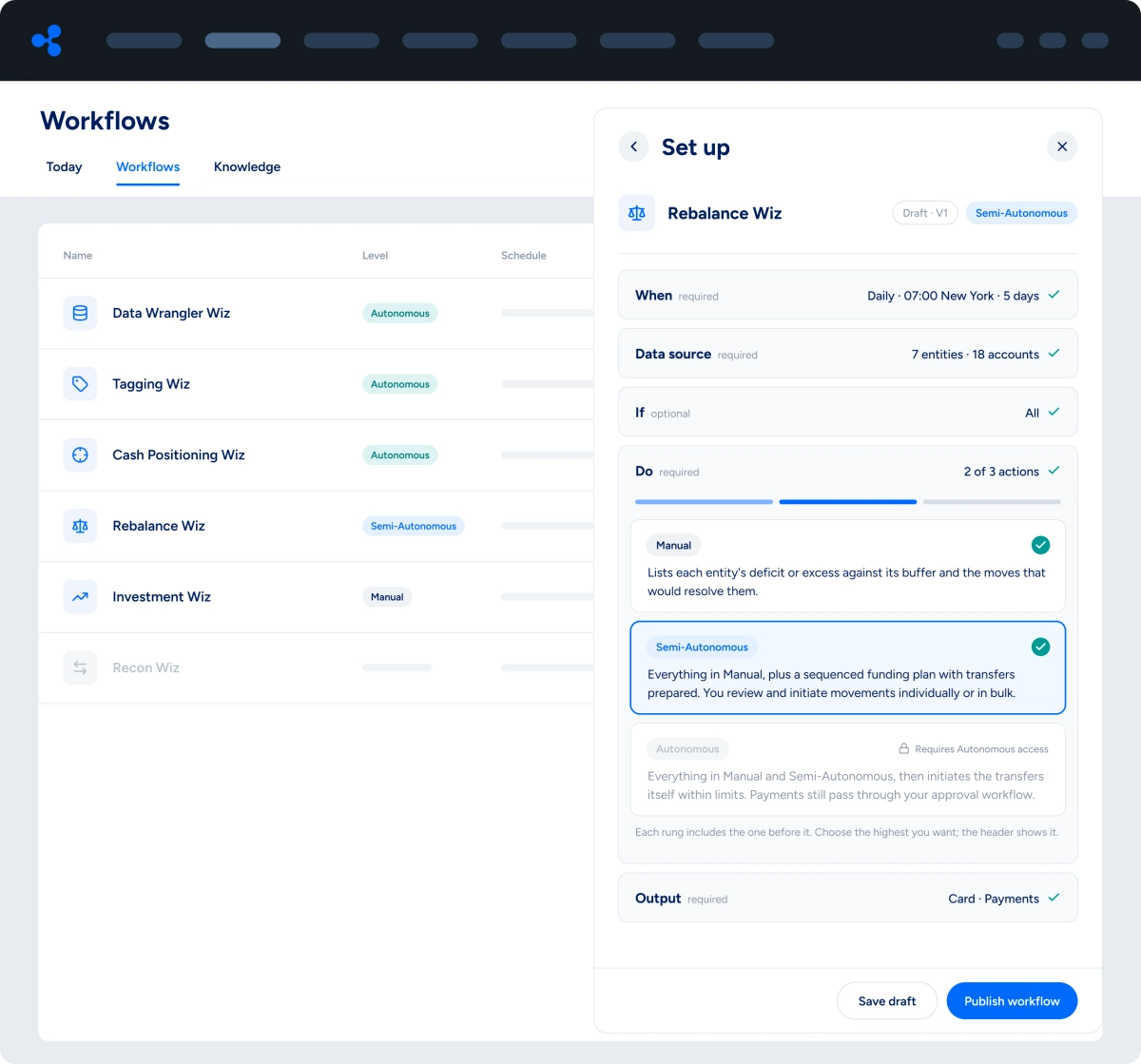
The orchestration layer runs your day at the level of autonomy you set. Choose a setting for each workflow, and change it whenever you want.
- Set it per workflow, not per platform. Overnight sweeps can run on their own while FX hedging still asks first.
- Move up the dial when it’s earned. Approve the same proposal nine times in a row and the system offers to promote that workflow.
The convergence
Separately, three trends. Together, one shift.
Adaptable solutions gave treasury its foundation. AI collapsed the time it takes to decide. Digital rails are collapsing the time it takes to act.
Controls are not the brake on always-on treasury. They’re the reason it’s possible.
What changed
From business days to 24/7: treasury operations need to be “always-on”
For decades, treasury ran on the business day. Positions closed at the end of day, files went out at cut-off and liquidity swept on a schedule. That rhythm made sense when the market kept the same hours. It doesn’t anymore.
| From Business Days | To Moments | |
|---|---|---|
Your position is accurate as of yesterday’s close | Your position is current at any hour of the day | |
Liquidity is swept on a schedule | Liquidity is positioned in advance of need | |
Cross-border waits for the cut-off | Cross-border settles anytime | |
Controls are checked after the fact | Controls run before the money moves | |
Forecasting is a monthly exercise | Forecasting is continuous |
Why Ripple Treasury
Solutions and AI are becoming standard. How they work together isn’t.
Within a few years, every treasury vendor will offer broad solutions and AI. What sets a partner apart is how that AI is governed, whether the trail stays unbroken from decision to settlement, and whether they’ll still be investing in it.
Opportunity and exposure
The same shift. Two sides of it.
The partner question
The easy path is to assemble it. One vendor at a time.
Treasuries are adding capability piece by piece, and many treasury platforms are doing the same, bolting on stablecoin settlement, investment access and AI through partners.
Each piece works. Together, they add counterparties and break the audit trail. When a payment fails at 2am, you don’t need a tool to blame. You need a partner to call.
You want to be a strategist. That path makes you the integrator.
An assembled stack
Treasury systemCounterparty 1
AI vendorCounterparty 2
Digital rail providerCounterparty 3
Custody and walletCounterparty 4
Continuous by design, governed by default
From decision to settled cash, in one motion.
Here’s what a weekend funding move looks like when treasury controls, the AI and the rails sit with one partner.
Where to start
Always-on doesn’t mean all at once.
You don’t have to replace your treasury to modernize it. Start with any solution, wherever your need is greatest, and adopt the rest at the pace your team can absorb. If speed to value matters most, these three can go live in 90 days.
90 days to go live with Liquidity Management, Cash Forecasting or Netting. Every other solution can be your starting point too.
Market signals
This isn’t a prediction. It’s happening now.
Central banks and market infrastructure are extending settlement hours now, and instant payments are already live. When settlement runs continuously, liquidity management has to run continuously too, with cash positioned in advance and intraday.
Euro area • Instant payments
Overnight liquidity nearly tripled in three months.
After the EU instant payments mandate, overnight euro liquidity held in TIPS rose from €32.3bn to €88.8bn.
Source: ECB, TARGET Services Annual Report 2025
€32.3bn Sept 2025 | €88.8bn Dec 2025 |
Evaluating treasury partners
Five questions to ask any treasury partner.
- When a digital payment moves wrong, which company fixes it, and is it the one you signed with?
- Does your AI cite the policy behind each action, and who approves it?
- Can you choose how much each workflow runs on its own, and see the approval record behind that choice?
- How many counterparties sit between our decision and settled cash?
- Who will still be investing in this platform in ten years?
FAQ
Common questions
It’s an operating model where treasury runs on the moment rather than the business day. Positions stay current, liquidity is positioned in advance and controls run continuously, so money can move whenever the job requires it and you can prove how it moved.
No. Real-time describes how fresh your data is. Always-on describes how the whole operation runs, including when controls run, when liquidity is positioned and when money can move.
24/7 treasury management means positions, liquidity and controls keep working outside the business day, including overnight and on weekends. It's the outcome of always-on corporate treasury: the operation keeps running so your team doesn't have to, and you decide which moves need a person.
When payments settle in seconds at any hour, liquidity can’t wait for an end-of-day sweep. Treasury needs a current position across entities, forecasts that update as actuals land and funding in place before it’s needed, with controls that run before money moves.
No. Start with any solution, wherever your need is greatest. Liquidity Management, Cash Forecasting and Netting can go live in 90 days. Add other solutions at the pace your team can absorb. Explore the treasury management system
No. Digital rails are infrastructure that sits underneath your existing workflows. You choose the rail that fits each job, fiat or digital, and can keep your traditional banking rails exactly as they are.
No. Most corporate payment value still moves through them, and will for a long time. Always-on matters most for the flows where timing has economic value.
You set it. Each workflow runs manually, semi-autonomously or fully autonomously, and you can move it up when your approvals show it has earned it. Policy checks run on every action at every setting, agents step back to a person when something falls outside what they've seen, and every action is traced.
No. Every workflow can run manually, semi-autonomously or fully autonomously, and you can change the setting at any time. Many teams start with every workflow on manual and move them up as the record builds.
Get Started
See Ripple Treasury in action
Get connected with supportive experts, comprehensive solutions, and untapped possibilities today.