Product Information
One view. Every balance. Digital and traditional assets, together.
See total liquidity across cash and digital assets in one dashboard, with the same drill-down depth for both.
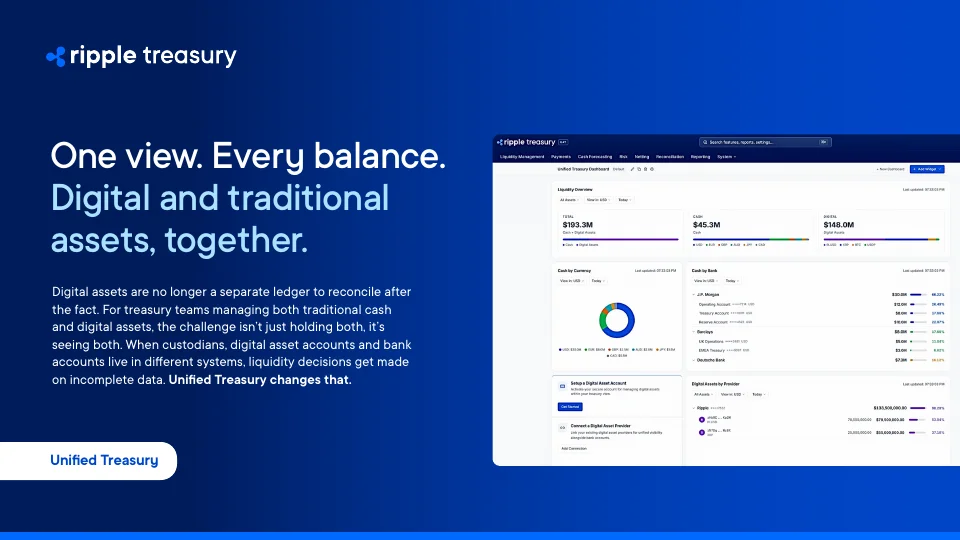
Unified Treasury changes that. Ripple Treasury brings digital asset positions, digital asset account balances and traditional cash into a single dashboard, giving you a real-time, holistic view of everything you hold, in every currency and every form.
Connect to Ripple's or other digital asset provider’s accounts through ClearConnect, and your digital asset account data flows directly into the platform alongside your bank accounts. Balances and transactions update automatically. Your treasury team finally has the full picture, without stitching it together manually.
Key Features
Digital Asset Connectivity
Connect to Ripple's infrastructure or other digital asset providers via API through ClearConnect. Onboard digital asset accounts in minutes using standard API credentials, and select exactly which digital asset accounts and data types to import.
Unified Liquidity Dashboard
See total liquidity across cash and digital assets on a single homepage dashboard. Drill into positions broken down by currency, digital asset type, custodian or bank, with the same drill-down depth you have for traditional cash.
Real-Time Market Rates
Digital asset balances are valued in your reporting currency using live exchange rates sourced from CryptoCompare, refreshed within seconds. Rates apply at the time of import and whenever a balance is displayed.
15-Decimal Precision
Most systems round digital asset balances, creating small but compounding discrepancies that surface as reconciliation gaps. Ripple Treasury captures native notional to 15 decimal places, so every unit is recorded exactly as it exists on-chain. Every balance is exact. Every unit is accounted for.
Native Notional Tracking
View positions in native digital asset terms (XRP, RLUSD and others) alongside their real-time fiat equivalent. Switch reporting currency for display without changing your underlying data.
Custodian-Aware Account Structure
Custodians are treated as equivalent to banks. Digital asset accounts behave like bank accounts. The existing account tree structure applies to digital assets, so your configuration model stays consistent across the platform.
Automated Transaction Sync
Digital asset account transactions and balance changes sync automatically as they occur. No manual imports, no batch delays. Every event on a connected digital asset account is reflected inside Ripple Treasury in real time.
Customizable Widget Layout
Build your own Unified Treasury dashboard from a library of purpose-built widgets, including liquidity overviews, live market data tiles, digital asset position lists and liquidity allocation views.
Use Cases
Managing combined cash and digital liquidity in one view
Treasury teams holding both traditional bank balances and digital asset positions across multiple custodians struggle to get a consolidated liquidity picture. Unified Treasury aggregates all positions into one dashboard, with real-time values in your reporting currency, so you can make liquidity decisions on complete data rather than a partial view.
Onboarding a new digital asset custodian
When a company adds a new custodian or expands its digital asset footprint, connecting to Ripple Treasury takes minutes. Use the connectivity tab to input API credentials, select which digital asset accounts to include, and choose whether to import balances, transactions or both. The system handles the data import and sets up ongoing sync automatically.
Monitoring counterparty concentration across banks and custodians
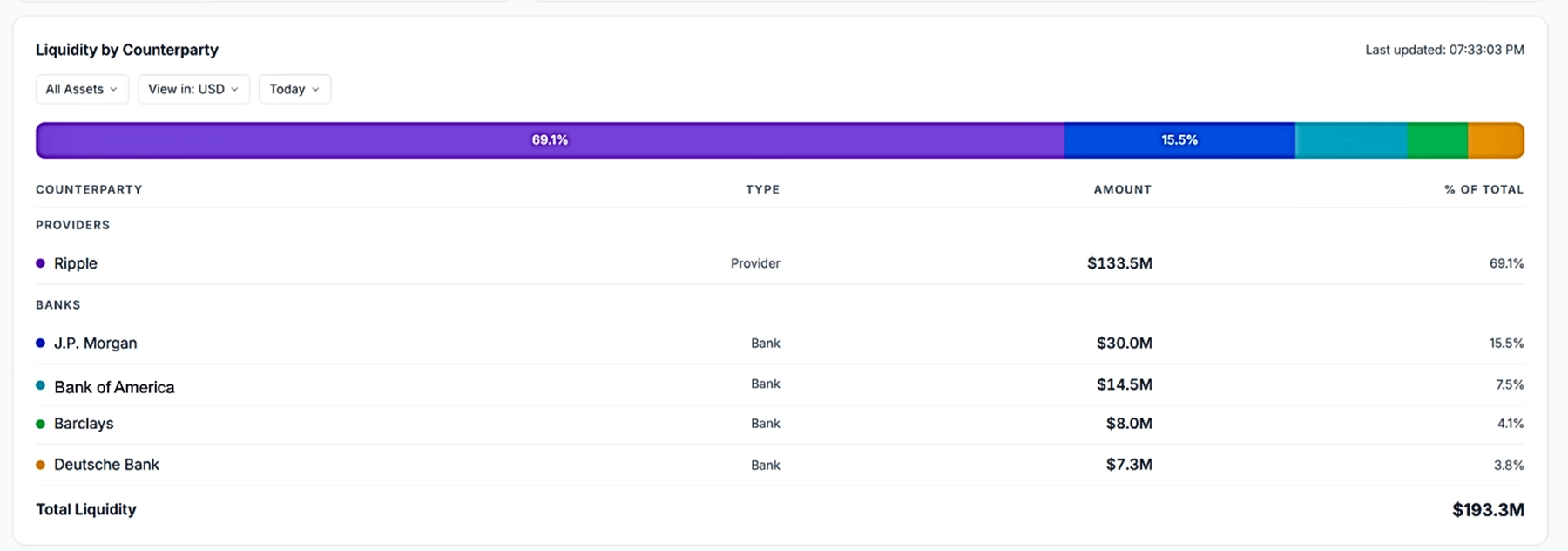
Liquidity concentration risk doesn't stop at banks. Unified Treasury lets you see your overall liquidity by counterparty, including both banking relationships and digital asset custodians, in a single view. Teams managing counterparty limits have the visibility they need to stay within policy.
Reporting digital asset positions alongside traditional cash
Finance teams preparing board packs or regulatory submissions need to present a complete view of the company's liquid assets. Unified Treasury surfaces digital and fiat positions in the same reporting structure, so there is no need to manually combine data from separate systems before reporting.
Who Benefits
Treasurer
Total liquidity across digital and traditional assets is visible in one place, updated in real time. Counterparty concentration, currency exposure and available headroom are all accessible from a single dashboard, without assembling data from multiple systems.
CFO
Digital assets appear in the same reporting structure as cash. Board and executive reporting reflects a complete picture of the company's liquid assets, with no manual consolidation required before presentation.
Treasury Operations
Digital asset account connections are set up through a guided workflow. Ongoing sync is automatic. Teams spend less time on data gathering and more time on the analysis and decisions the data enables.
Financial Controller
Digital asset transactions are recorded with the same discipline as traditional cash, with native notional, fiat equivalent and exchange rate captured at the time of each event. Reconciliation and audit trails are built into the platform.
Why Ripple Treasury
Most treasury teams that hold digital assets manage them separately from cash. Custodian portals provide digital asset account data. The TMS handles bank accounts. Someone, usually in treasury operations, pulls both together manually when a consolidated view is needed. That process introduces delays, inconsistencies and operational risk.
Ripple Treasury treats digital assets as first-class citizens in the platform. Custodians are structured like banks. Digital asset accounts behave like bank accounts. The same liquidity management capabilities that apply to traditional cash, including worksheets, account trees, balance tracking and transaction recording, extend naturally to digital assets.
The result is a single system of record for your entire liquidity position. Decisions get made on complete, current data. Reporting requires no manual assembly. And as digital asset use expands, the platform scales with it, across custodians, digital asset account types and digital asset classes.
See Ripple Treasury in action
Get connected with supportive experts, comprehensive solutions, and untapped possibility today.