Product Information
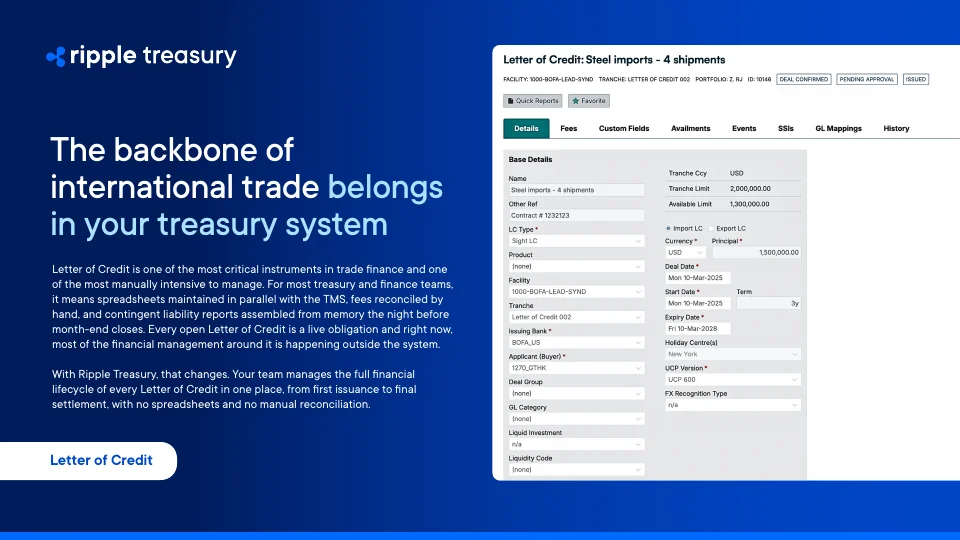
The backbone of international trade belongs in your treasury system
Manage the full financial lifecycle of every Letter of Credit in Ripple Treasury, from first issuance to final settlement, with no spreadsheets.
Full Letter of Credit Lifecycle, Fully in the System
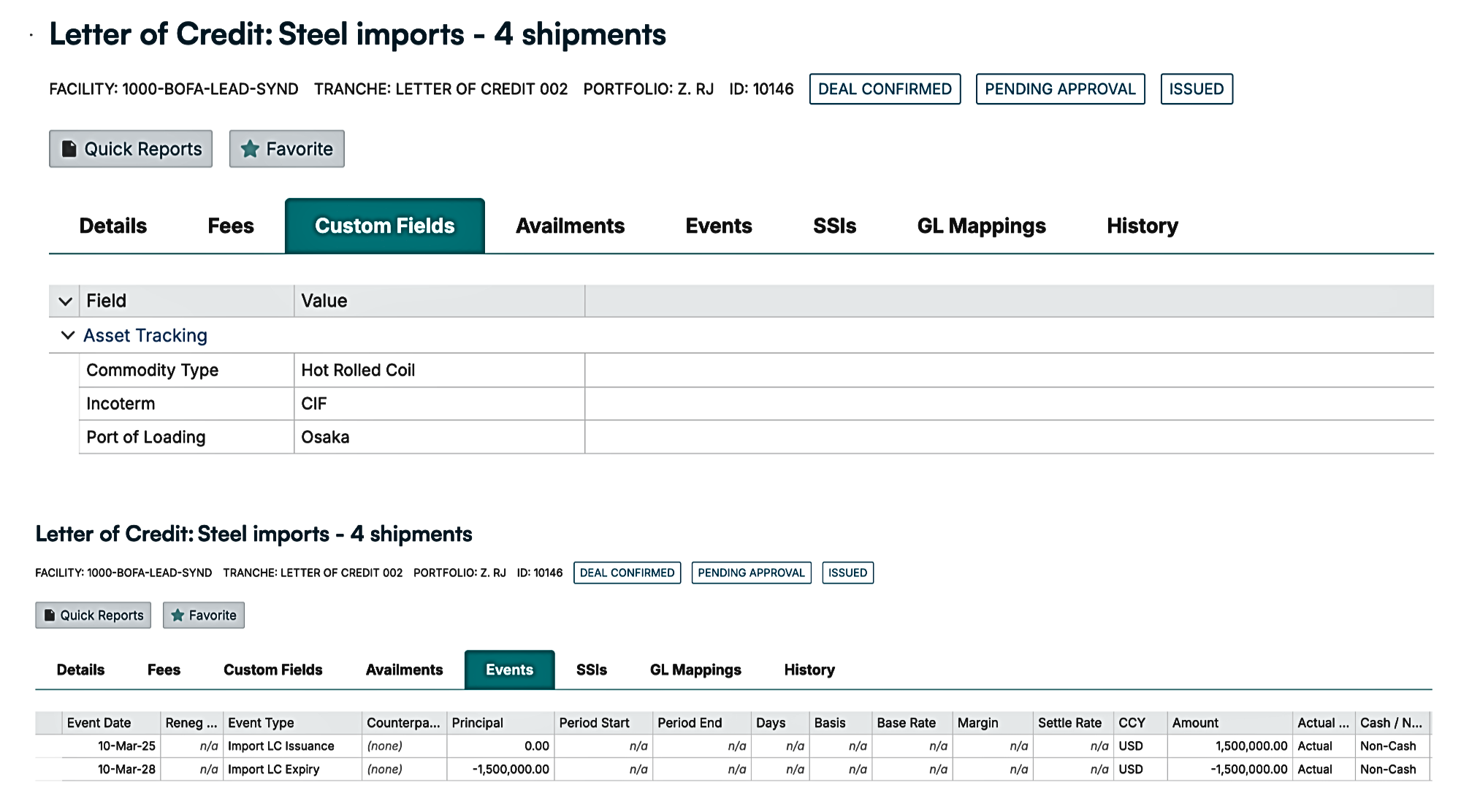
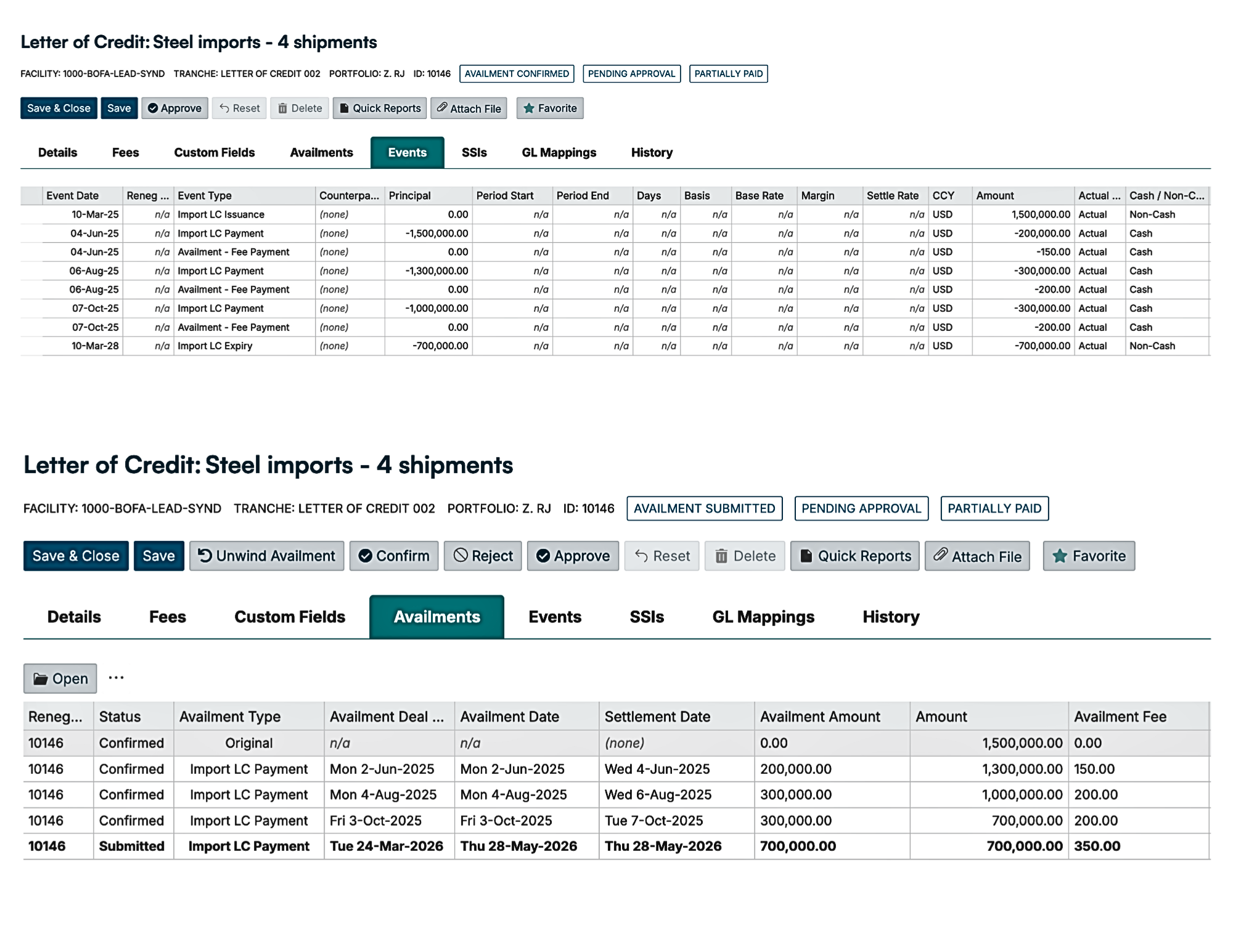
Ripple Treasury manages every financial event across the Letter of Credit lifecycle within the same platform your team uses for every other treasury instrument. Facility utilization is tracked in real time across all banking relationships, updating automatically as LCs are issued, amended, or drawn so that available headroom is always current. Commitment, issuance, and amendment fees are accrued automatically based on agreed terms, with full calculation detail that makes discrepancies visible before they reach the books rather than after.
Event-based accounting means that drawings, amendments, expiries, and cancellations are classified and posted at the point they occur, not during a manual reconciliation exercise at month-end. Advanced limits tracking monitors issuances and drawings against established controls and routes any approaching or exceeded limit through the correct approval workflow automatically. For high-volume portfolios, batch operations support importing and updating large numbers of Letters of Credit, payments, and fees in a single operation, enabling teams managing hundreds of active LCs to execute at scale without manual entry.
Key Benefits
Eliminate Parallel Tracking for Good
When the full Letter of Credit lifecycle (issuance, amendments, drawings, fees, and status) lives in the TMS, the spreadsheet that has been running alongside it for years becomes unnecessary. Treasury operations teams gain a single source of truth that is current, attributable, and consistent, without the synchronization effort and version control risk that parallel systems create. The energy that went into maintaining a secondary record goes back to the work that requires judgment.
Know Your Exposure the Moment It Changes
Facility headroom, contingent liability positions, and active LC status are updated in real time as events occur. Treasurers and financial controllers reviewing trade finance exposure see the current position, not yesterday's export, and the sign-off they provide is backed by live system data rather than a report assembled the night before. When a counterparty makes a partial drawing or an amendment changes the financial terms, the impact is reflected immediately across facility tracking, accounting, and reporting.
A Month-End That Does Not Require a Reconciliation Sprint
Because drawings, amendments, expiries, and fee accruals are captured and posted as they happen, the work of period-end close for Letters of Credit is already done by the time the period ends. Financial controllers are not reconstructing activity from email threads and bank statements. They are confirming a position that has been building accurately all month. Point-in-time historical reporting means any retrospective query, whether from an auditor, a regulator, or a business unit, can be answered from standard reports without manual reconstruction.
Scale Trade Volumes Without Scaling Headcount
As trade relationships grow and LC portfolios expand, the operational overhead of managing them manually scales directly with volume. Ripple Treasury decouples trade finance complexity from administrative burden: batch operations handle high-volume portfolios efficiently, automated controls enforce limits without manual monitoring, and approval workflows route exceptions to the right people without coordination overhead. Teams that would otherwise need to add headcount to absorb growth can instead absorb it within the existing team.
Key Features
Facility Utilization Tracking
Real-time visibility into available headroom across all banking facilities, updated automatically as Letters of Credit are issued, amended, or drawn. Consolidated multi-facility views give treasury leaders an accurate picture of committed and available capacity without manual aggregation.
Event-Based Accounting
Drawings, amendments, expiries, and cancellations are classified and posted at the point they occur. Month-end close does not depend on a manual reconciliation exercise because the accounting entries are already in the system when the period ends.
Advanced Limits Tracking and Breach Approvals
LC issuances and drawings are monitored against established limits automatically. When a Letter of Credit approaches or exceeds a limit, it is routed through the correct approval workflow before it can proceed, enforcing the right controls without requiring manual oversight.
Complete Audit Trail
Every financial action across every Letter of Credit is timestamped and attributed in the system, available on demand from standard reports. Audit queries and regulatory reviews are answered directly from the platform without manual reconstruction of activity from email or bank statements.
Automated Fee Accrual
Commitment, issuance, and amendment fees are tracked and accrued against each Letter of Credit based on agreed terms, with full calculation detail. Discrepancies between accrued amounts and bank charges are surfaced immediately when an invoice arrives, before they reach the books.
Amendment Management and Approval Workflows
When terms change, the financial impact moves through a structured approval process and updates the live LC position directly. No offline tracking, no email thread to reconstruct, and no risk of the system and the spreadsheet falling out of sync.
Batch Operations
High-volume LC portfolios are managed efficiently through batch processing, supporting the import and update of large numbers of Letters of Credit, payments, and fees in a single operation. Teams handling hundreds or thousands of active LCs can execute bulk actions without manual entry, reducing processing time and error risk at scale.
Point-in-Time Historical Reporting
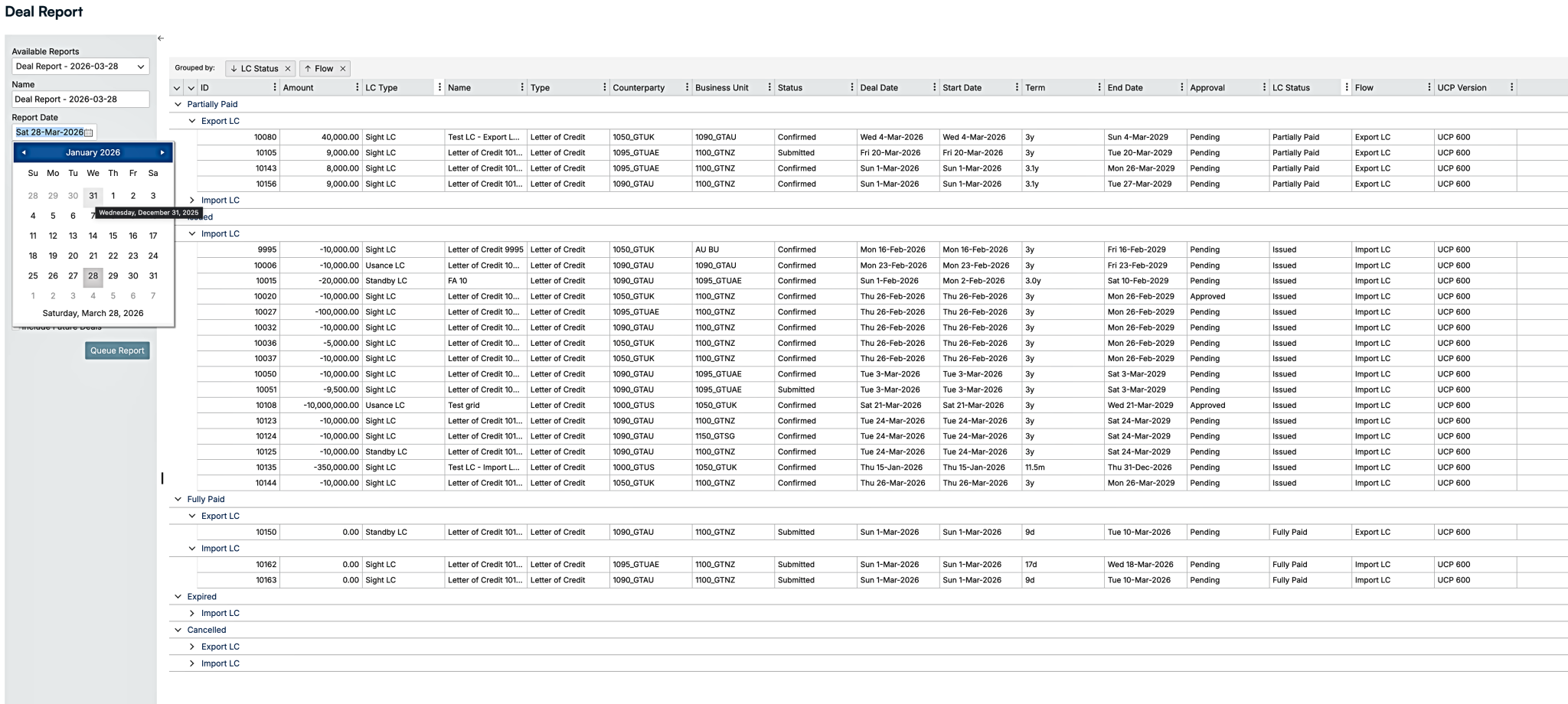
Run reports against any historical date to review the outstanding balance, status, and full activity of every Letter of Credit as it stood at that moment. Useful for period-end reporting, regulatory reviews, and answering retrospective queries without rebuilding data from scratch.
Use Cases
Consolidated Multi-Bank LC Portfolio Management
Organizations with active trade relationships across multiple banking facilities struggle to maintain a current view of commitments and available headroom. Ripple Treasury aggregates all Letters of Credit across facilities into a single real-time position, so treasury leaders always know where capacity stands across every banking relationship.
Bank Fee Reconciliation
Bank fee invoices rarely arrive with line-item detail that maps cleanly to agreed schedules. Ripple Treasury accrues fees based on agreed terms throughout the LC lifecycle and flags variances the moment a bank charge is received, giving finance teams the information they need to dispute discrepancies rather than absorb them.
Audit and Regulatory Review Preparation
Contingent liability reporting and trade finance audit trails are notoriously difficult to reconstruct from spreadsheets and email threads. Ripple Treasury maintains a complete, timestamped record of every financial action across every Letter of Credit, available on demand so that audit preparation is a reporting exercise, not a reconstruction project.
Partial Drawings and Mid-Cycle Amendments
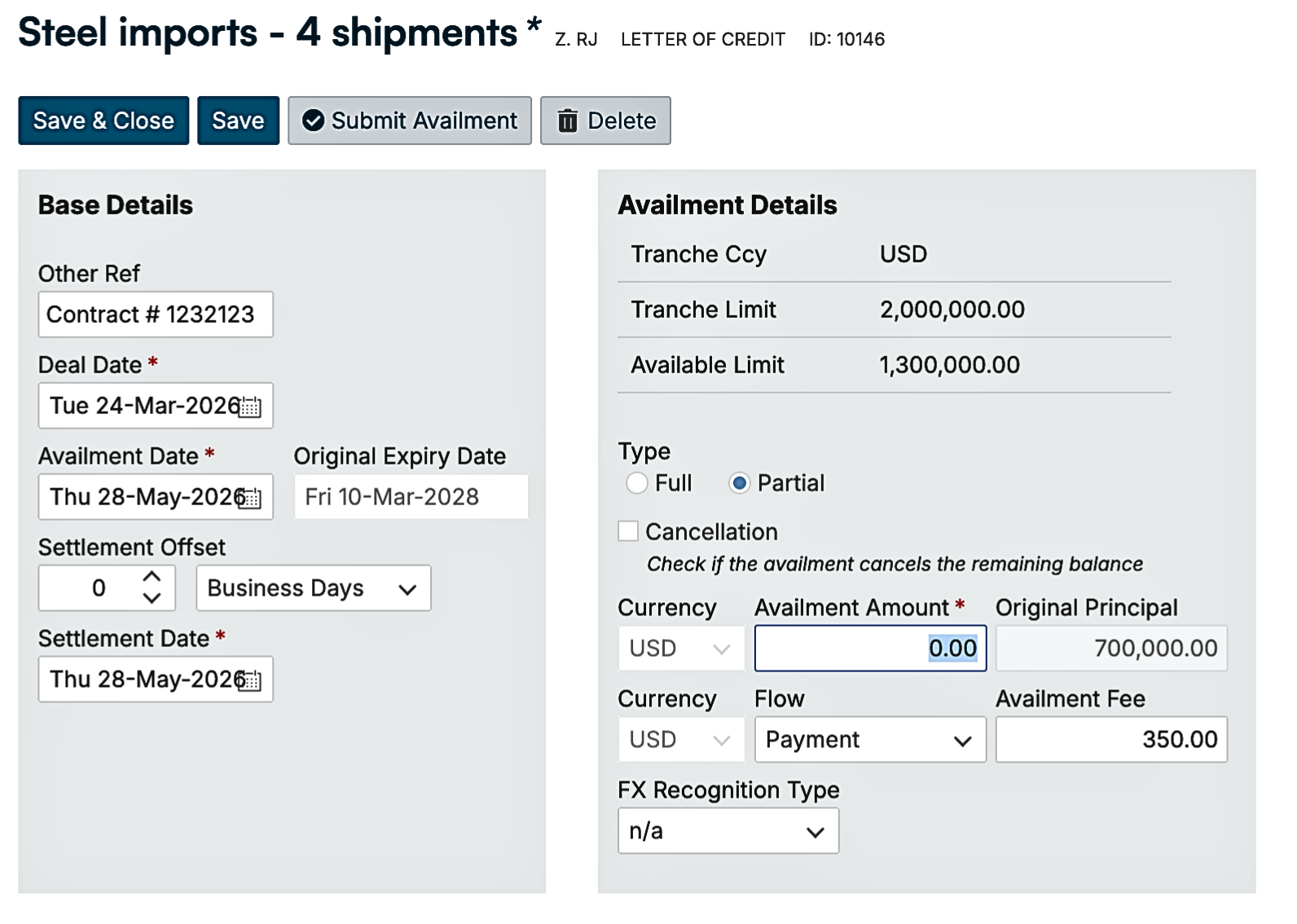
When a counterparty draws 30% of the original principal, that single event cascades through facility headroom, accounting entries, and fee accruals. Ripple Treasury captures the full financial impact, routes it through the appropriate approval workflow, and reflects it in the live position automatically, with no manual follow-through required.
Import and Export LC Programs
Whether the business is issuing Letters of Credit to overseas suppliers or receiving them from international buyers, both import and export instruments are managed within the same platform, with consistent financial tracking, approval workflows, and reporting across both directions and all banking relationships.
Scaling Trade Finance Without Adding Headcount
As trade volumes grow, automated fee accrual, event-based accounting, and batch operations absorb the operational load that would otherwise require manual processing. Teams managing a growing LC portfolio can scale activity within the existing team rather than adding administrative overhead proportionally with volume.
Who Benefits
Treasurer Trade finance exposure and facility headroom are visible the moment an event occurs. Contingent liability sign-off is backed by live system data, not a report assembled the night before.
Financial Controller Letter of Credit events are classified and posted correctly as they occur. Month-end close doesn't depend on a reconciliation exercise, and audit queries are answered from standard reports, not reconstructed after the fact.
Treasury Operations The full Letter of Credit lifecycle covering issuance, amendments, drawings, fees, and status is managed within the TMS. Parallel tracking outside the system is no longer necessary.
Head of Trade Finance A higher volume of Letters of Credit can be managed without a proportional increase in operational overhead. The process scales with the business.
Why Ripple Treasury
Most teams manage Letters of Credit across a patchwork of spreadsheets, email threads, and systems that were never designed for trade finance. The financial management layer gets handled manually, which means it gets handled inconsistently, and the gaps only surface at the worst moments: a disputed fee, a missed drawing, an auditor's request that takes days to answer.
Ripple Treasury is purpose-built to close those gaps. Letter of Credit shares the same engine as every other instrument in the platform, so facility tracking, GL posting, and event recording are fully integrated with no synchronization delay and no secondary system to maintain. Advanced limits tracking and breach approval workflows are included out of the box. When a Letter of Credit issuance or drawing approaches its limits, the right controls are enforced automatically, before a problem occurs, not after.
See Ripple Treasury in action
Get connected with supportive experts, comprehensive solutions, and untapped possibility today.