Product Information
Treasury-Native AI: Every Move Proposed, Every Clause Cited
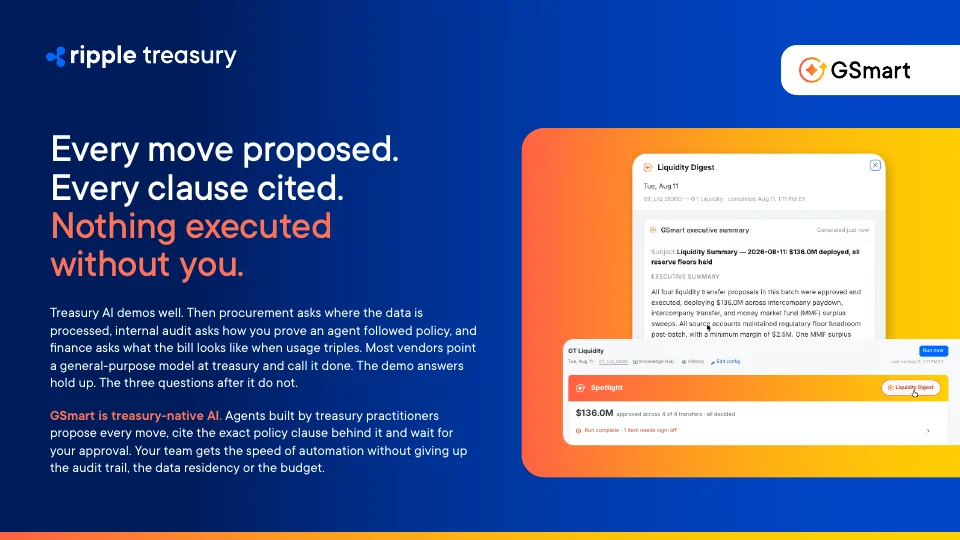
GSmart is treasury-native AI. Agents propose every move, cite the policy behind it, and wait for your approval. Automation speed, full audit trail.
The Three Questions After the Demo
Treasury AI demos well. Then procurement asks where the data is processed, internal audit asks how you prove an agent followed policy, and finance asks what the bill looks like when usage triples. Most vendors point a general-purpose model at treasury and call it done. The demo answers hold up. The three questions after it do not.
Each question maps to a real exposure. Usage-metered AI turns success into a cost problem, because the teams getting the most value generate the biggest bill. An AI decision nobody can explain is an audit finding. And an agent executing outside your guardrails is a control failure with a cash consequence attached. The risk in treasury automation is not that it runs slowly, it is that it acts.
Each question maps to a real exposure. Usage-metered AI turns success into a cost problem, because the teams getting the most value generate the biggest bill. An AI decision nobody can explain is an audit finding. And an agent executing outside your guardrails is a control failure with a cash consequence attached. The risk in treasury automation is not that it runs slowly, it is that it acts.
Treasury Is the Foundation. The AI Was Built On It.
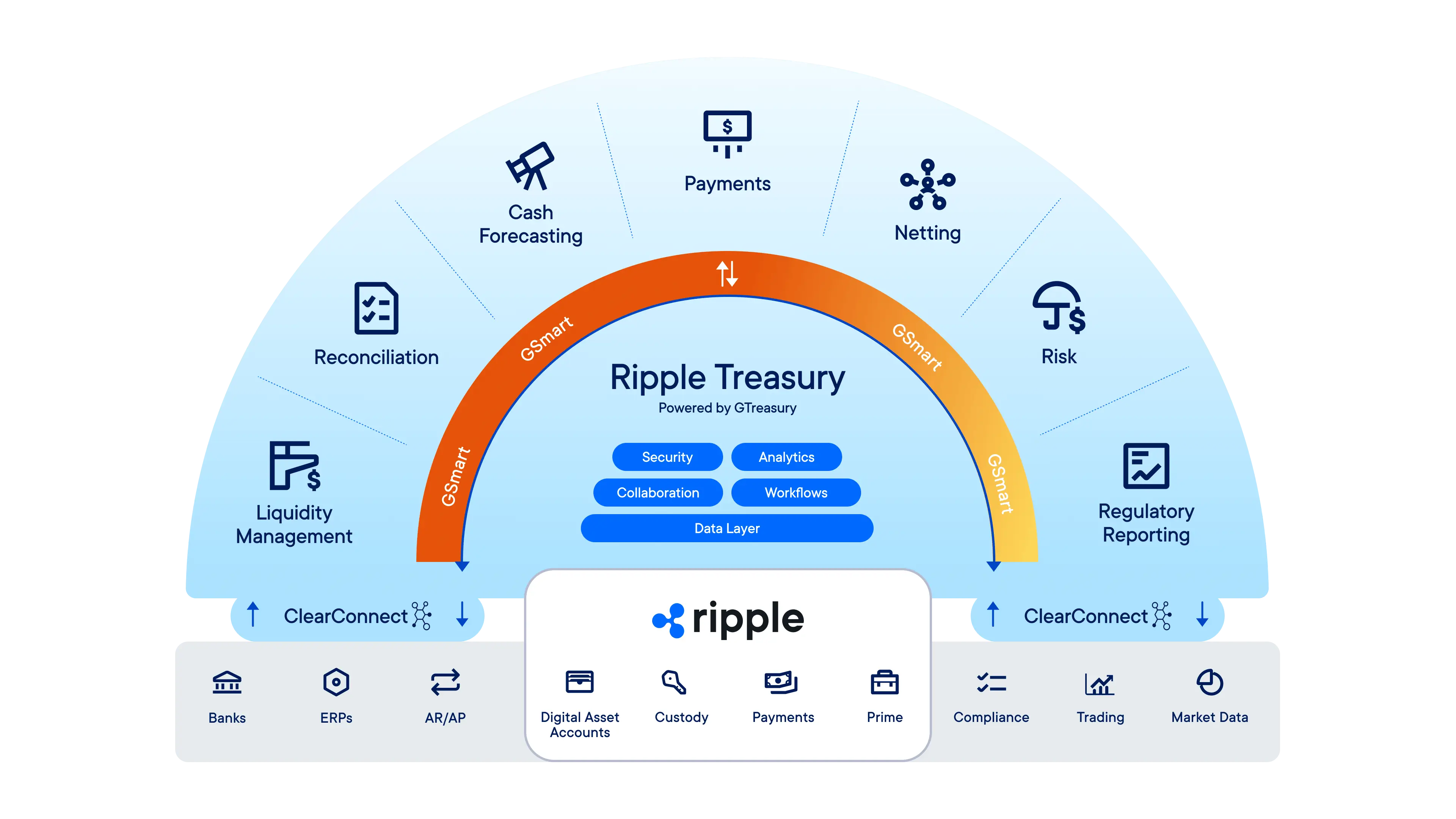
Treasury-native AI means the domain was the starting point, not a layer added on top. Most treasury AI is a general-purpose model pointed at treasury data after the fact. GSmart was built the other way round, by people who have spent careers inside the work. Three things follow from that. The data foundation is purpose-built, because AI is only ever as good as the structures underneath it. The judgment is built in, because it was built by people who can tell a routine exception from the one that needs a human, and from the one that should never be automated at all. And you govern it, not the vendor.
GSmart agents are not chat windows waiting for a prompt. Every agent that can move or commit cash follows the same sequence. It proposes a specific action when one is needed, a sweep amount, a hedge adjustment, a payment to hold. It cites the exact policy clause that authorizes it, drawn from the controls you defined in Knowledge Studio, and you see the clause itself rather than a paraphrase of it. Then you approve. Nothing executes until a person approves it, and the proposal, the citation, the approver and the timestamp are all captured.
The figures inside a proposal are calculated by a deterministic engine rather than generated by AI, so a number cannot be invented.
Key Benefits
No hidden costs
No hidden consumption charges. When pricing does not scale with consumption, the case for AI strengthens as adoption spreads instead of eroding, and finance can forecast the line item. AI adoption expands as fast as your treasury needs, without a budget penalty.
Enterprise grade
In-region data residency for supported geographies, with per-client isolation. The best-suited model is matched to each AI experience and evaluated continuously, so no one model becomes a single point of failure. Your data is tenant-isolated and is never used to train shared AI models
Governance
Outline policies and rules in Knowledge Studio to convert static policy and tribal knowledge into AI controls. Every action cites the control that drove it and writes to a complete audit log, so the compliance evidence is a by-product of the work instead of a project every quarter.
Policy-cited agentic control
Every agent that can move or commit cash proposes, cites the exact clause and waits. You set the autonomy limits per agent, and nothing executes until a person approves it. Your approvals and overrides refine your tenant’s policies and guardrails over time - the model itself is never trained on your data.
Key Features
Forecast Insights
Compares forecast to actuals and flags meaningful drift as it happens.
Forecast Chaser
Chases overdue forecast submissions automatically, validates entries and flags anything off.
Liquidity Scenarios
Models what-if funding and liquidity scenarios ahead of time.
Yield
Proposes cash placements against yield curves and policy limits, pre-checked.
Risk Insights
Surfaces exposure anomalies, policy breaches and hedge deviations, with plain-language analysis.
Fraud Protection
Flags payments that break from your normal patterns, before they clear.
AI Matching Rules
Reads sample data and suggests candidate reconciliation matching rules in seconds.
Ask GSmart: In-Product Help
Helps users navigate the application, raise support tickets when necessary and query their own data.
Trend Insights
Detects seasonality and outliers in history, then recommends the best-fit forecast model.
Ledger
Builds short-term cash forecasts from AP and AR ledgers and payment behavior.
Rebalance
Proposes the cash moves your limits and targets call for, routed for your approval.
Liquidity Digest
Packages liquidity data into a board-ready summary.
Counterparty Monitor
Monitors counterparty risk and concentration against the limits you set.
Document Capture
Extracts structured data from checks, remittances and bank statement documents.
Ask GSmart: Analytics Assistant
Answers plain-language questions about your data.
Smart Mapping
Pre-built ERP and bank connectors align and validate your data in days.
Use Cases
Daily liquidity rebalancing
Rebalance proposes the cash moves your limits and targets call for, cites the funding order and floor that justify each one, and routes them for approval. Nothing moves on its own.
Exposure and counterparty monitoring
Risk Insights surfaces anomalies, policy breaches and hedge deviations in plain language, while Counterparty Monitor tracks concentration against the limits you set.
Month-end reconciliation
Document Capture extracts structured data from checks, remittances and bank statements, and AI Matching Rules suggests candidate matching rules from sample data in seconds.
Forecast cycle management
Forecast Chaser pursues overdue submissions and validates entries, Forecast Insights flags drift against actuals, and Trend Insights recommends the best-fit model for the next cycle.
Payment fraud screening
Fraud Protection flags payments that break from your normal patterns before they clear, so the review happens ahead of settlement rather than after it.
Governed self-service analytics
Ask GSmart, the optional AI for Analytics Studio, answers plain-language questions from the same governed data warehouse that powers your official reports, so every answer traces back to one definition of cash, liquidity and exposure.
Automation You Can Widen Without Widening Risk
Approval gates and clause-level citation are what let you extend treasury-native AI across more of the work without taking on more control risk. Agents operate inside the policy limits you set, you decide the autonomy for each one, and you can withdraw it.
"GSmart proposes. It does not move money on its own."
See Ripple Treasury in action
Get connected with supportive experts, comprehensive solutions, and untapped possibility today.