Product Information
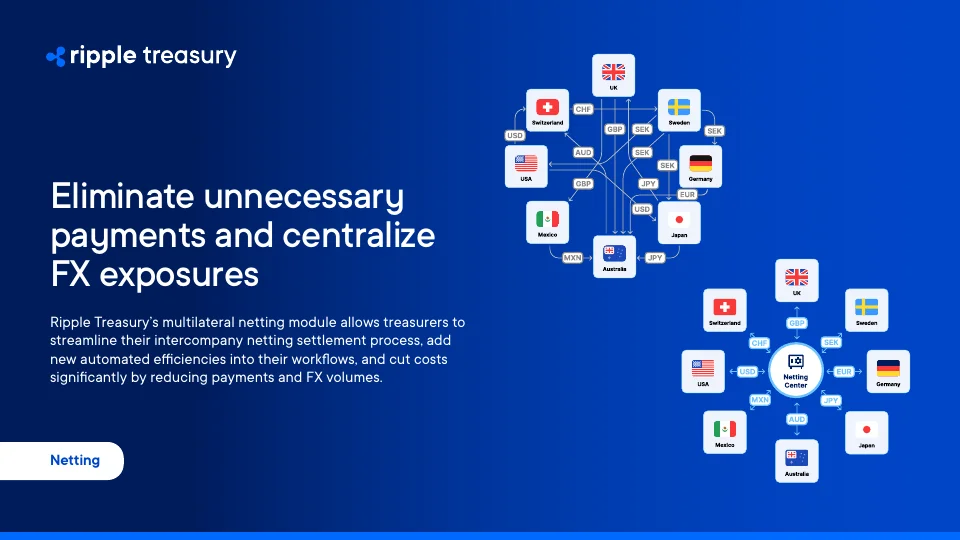
Eliminate unnecessary payments and centralize FX exposures
Ripple Treasury’s multilateral netting module cuts cross-border transfers by as much as 70% while reducing FX and bank fees.

The Hidden Cost of Unstructured Intercompany Payments
Each entity in a corporate group typically handles its own AR and AP independently, converting to base currency in order to make intercompany payments. This results in paying multiple transaction fees on every cycle, with small and numerous FX deals at each subsidiary driving up costs. Without a centralized view of exposures, payment dates are uncertain, hedging is difficult and expensive, and there is no structure or discipline to the intercompany payment process.
Reconciliation compounds the problem. Mismatches on the consolidated balance sheet, delays in booking AP, and a high volume of manual workload at every subsidiary create pressure at period close. Reconciled data and documentation are rarely stored centrally, making it hard for auditors to get what they need and for corporate treasury to maintain an accurate group-wide picture of intercompany obligations.
A Centralized Netting Center for the Entire Group
Ripple Treasury's netting solution brings structure and discipline to the intercompany payment process. Using a flexible calendar-based netting system, subsidiaries upload their AP and AR data and transactions are automatically matched. Each participant makes or receives one net payment per cycle in their home currency through a central netting center, minimizing conversions and reducing the number of FX deals across the group.
Beyond settlement, the platform covers the full reconciliation lifecycle. Automatic AP and AR matching, mismatch analysis with drilldown, and invoice-level discussion tools eliminate the manual back-and-forth between entities. Vendor payment centralization extends the same efficiency to third-party payables, with fixed payment runs and ERP interfaces giving corporate treasury a single view of all outgoing cash.
Key Benefits
Fewer Payments, Lower Bank Charges
By consolidating intercompany flows, each participant ideally makes or receives one net payment per cycle rather than dozens of bilateral transactions. This cuts bank fees significantly, reduces float, and simplifies cash management for subsidiaries and corporate treasury alike.
Less FX at Better Rates
Centralizing FX through a netting center reduces the volume of individual currency conversions across the group. Remaining FX is traded in aggregate, giving treasury access to better rates than subsidiaries could achieve independently.
Simplified Payment Procedures Across the Group
Fixed payment runs and a calendar-based netting cycle bring structure to what was previously an ad hoc, subsidiary-by-subsidiary process. Subsidiaries always know when payments will be made, making it easier to manage deadlines and plan cash positions.
Faster Reconciliation and Period Close
Automatic matching of all AP and AR data eliminates the bulk of manual reconciliation workload. Subsidiaries can concentrate on genuine mismatches, while mismatch analysis tools and a central data store support a faster, cleaner close and easy access to historical data for auditors.
Better Forecasting Accuracy
Full visibility over intercompany payment timing and amounts makes it easier to forecast cash needs accurately. Consolidated netting statements across the group replace fragmented subsidiary ledgers, reducing the uncertainty that makes hedging difficult and costly.
Key Features
Flexible Calendar-Based Netting System
Configure netting cycles to match the group's settlement schedule, with calendar-driven cut-offs that keep every participant aligned on timing and obligations.
Discussion and Disputes Management
An invoice-level discussion tool lets subsidiaries flag, discuss, and resolve disputes directly in the platform, replacing slow email chains with a structured, auditable dialogue.
Vendor Payments Management
Centralize third-party vendor payments with fixed payment runs and ERP data uploads, reducing bank charges and giving treasury an overview of the total volume paid to each vendor across the group.
API and ERP Connectivity
An available API automates data interfaces with banks and ERP systems, enabling straight-through processing and reducing manual data entry across the netting workflow.
Automated AP and AR Matching
Upload both AP and AR data, optionally via API, for automatic transaction matching. Mismatch analysis with drilldown lets teams focus only on genuine discrepancies.
Real-Time Netting Statements
All participants receive live netting statements reflecting their current position, giving subsidiaries and corporate treasury consistent, up-to-date visibility across the group.
Flexible Currency Management
Handle multiple currencies through the central netting center, reducing the number of FX conversions and allowing remaining exposures to be managed at the group level.
Use Cases
Multilateral Intercompany Settlement
Multinational groups with complex intercompany payment flows consolidate all settlements into single net transactions per participant, reducing payment volumes and bank charges across the group.
Intercompany AP/AR Reconciliation
Subsidiaries upload AP and AR data for automatic matching, enabling faster month-end close and eliminating the balance sheet mismatches that create audit risk and manual rework.
Bilateral Payments Outside the Netting Cycle
An excluded solution supports bilateral payment flows that sit outside the main netting cycle, giving treasury flexibility for edge cases without disrupting the core settlement process.
FX Exposure Centralization
Finance teams route all intercompany FX through a central netting center, reducing the number and cost of individual currency conversions and giving treasury a consolidated view of group FX exposure.
Vendor Payment Centralization
Corporate treasury centralizes vendor payments from multiple subsidiaries using fixed payment runs, improving FX rates through aggregation and reducing bank charges across the group.
Streamline Intercompany Payments Across the Entire Group
Ripple Treasury's netting solution transforms a fragmented, manual process into a structured, centralized settlement cycle that reduces costs and brings visibility to every corner of the group's intercompany obligations. Whether deployed as part of the full Ripple Treasury platform or as a standalone solution, Netting delivers measurable savings from the first settlement run.
"By funneling all transactions through a netting center, conversions can be minimized as payments are made in their original currency."
See Ripple Treasury in action
Get connected with supportive experts, comprehensive solutions, and untapped possibility today.