Blog

What Is a Cash Flow Forecast (Examples + Template)

What Is a Cash Flow Forecast? (Examples + Template)

Download
Table of contents
This is some text inside of a div block.

A cash flow forecast is a financial management tool used by finance and treasury professionals to estimate future cash inflows and outflows over a defined period. The primary purpose of cash flow forecasting is to support liquidity management by ensuring a company has sufficient funds to meet its obligations before shortfalls occur.

The larger the company, the more complex cash flow forecasting becomes. For a deeper dive into overall strategies and methods, see our complete cash flow forecasting guide.

In this post, we cover the main components of a cash flow forecast, why capturing actual cash flow data matters and the most common types of cash flow forecasts. We also provide a cash flow forecast example for different periods and a free cash flow forecasting template you can start using today.

What are the Components of a Cash Flow Forecast?

In its simplest form, a cash flow forecast shows where your cash balances will be at specific points in the future based on projected receipts and payments. This helps highlight when and where funding needs arise and allows you to take advantage of periods when excess liquidity is available.

A more comprehensive cash flow forecast shows your current cash position, whether you will have enough cash in the future, where that cash will be and what will happen along the way, including classified cash receipts and payments.

A complete cash flow forecast, whether you are working from a cash flow projection template or a live forecasting platform, typically includes:

  • Opening Balance: The starting cash position for the period.
  • Receipts: Projected cash inflows, broken down by cash flow item or classification.
  • Total Receipts: The sum of all incoming cash.
  • Payments: Projected cash outflows, broken down by cash flow item.
  • Total Payments: The sum of all outgoing cash.
  • Net Movement: The difference between receipts and payments, tracked by individual cash flow item or at a minimum as total net movement.
  • Closing Balance: The final projected cash position for the period.

Most cash forecasts structure these line items across standard weekly or monthly intervals. The cash flow items that make up the receipt and payment elements are unique to each business. Some companies track high-level accounts payable and accounts receivable cash flows; others break cash flows down to the level of individual customers and suppliers.

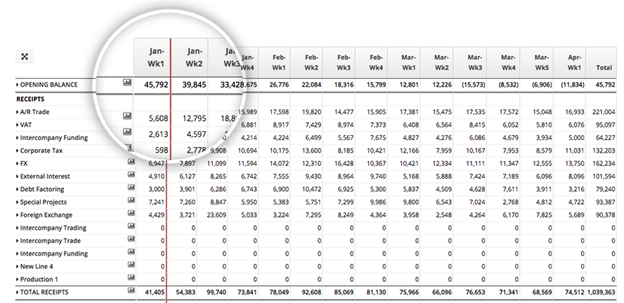
Broadly speaking, most cash forecasts will be structured as shown below. The image shows a cross-section of a 13-week cash flow forecast:
Why Is Cash Flow Forecasting Valuable?

Cash flow forecasting enables companies to anticipate shortfalls, optimize excess cash and make data-driven financial decisions. Beyond capturing projected positions, cash flow forecasts often incorporate actual cash flows in the same model or template.

There are four key benefits to capturing actuals in your cash forecasting model:

  1. It ensures projected cash flows start from the actual cash position, not an estimate.
  2. Historical cash flow data reveals patterns in cash fluctuation on a monthly or yearly basis that can be used to improve future projections.
  3. Comparing forecasted cash flows to actual results lets you measure and improve forecast accuracy over time through cash flow variance analysis, identifying where projections diverged from actuals and why.
  4. It helps companies avoid shortfalls by predicting cash availability in the months ahead. If a shortage is likely, finance teams can arrange funding before it becomes urgent.

Types of Cash Flow Forecasts

When setting up a cash flow forecasting template, you first have to decide how far into the future the forecast will look. This depends on your business needs and the availability of data within your organization. As a general rule, the longer the forecast, the less granular it will be.

Short-Term Forecasts

Short-term forecasts cover a period of one to four weeks and manage the day-to-day cash needs of a business. They provide a daily breakdown of cash on hand and expected receipts.

A daily forecasting process often includes automation to capture cash flows directly from bank accounts and ERP systems. Short-term forecasts are especially valuable for smaller businesses that need to know how much cash will be available for supplier payments and operating expenses, since they typically have less access to credit than larger organizations.

This example covers what a daily cash flow forecast would look like.

Medium-Term Forecasts

Medium-term forecasts project cash flows over one to six months. The 13-week cash flow forecast is the most widely used standard in enterprise treasury management, providing a full quarterly view for each submission.

Most organizations rely on accrual-based accounting, which records income based on invoice date rather than payment date. Medium-term forecasts account for this timing gap and help ensure there is enough cash to meet payment obligations as they fall due.
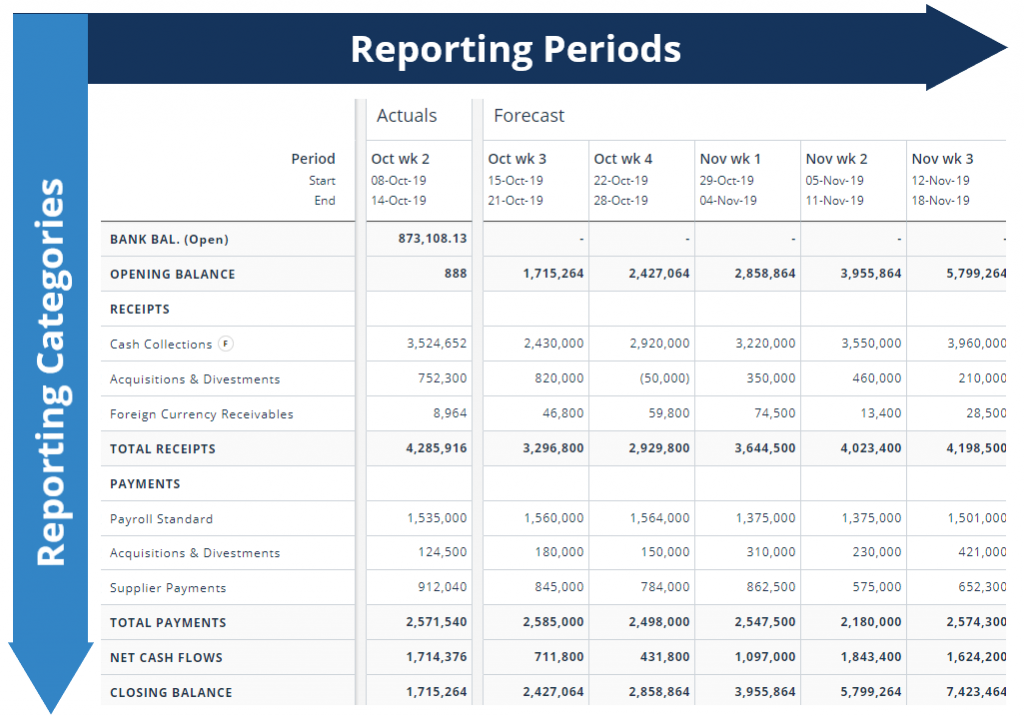
13-week forecasting model

LLong-Term Forecasts

Long-term forecasts project cash flows over 12 months or more, serving as strategic tools for annual budgeting and capital planning. They are the starting point for most budgeting processes and are important for assessing the cash required for growth strategies and capital projects.

Additionally, long-term forecasts are better suited for directional guidance than month-to-month decision-making, since the extended horizon reduces the reliability of individual projections. They are also essential for managing working capital and determining whether the business can self-fund its growth.

Mixed-Period Forecasts

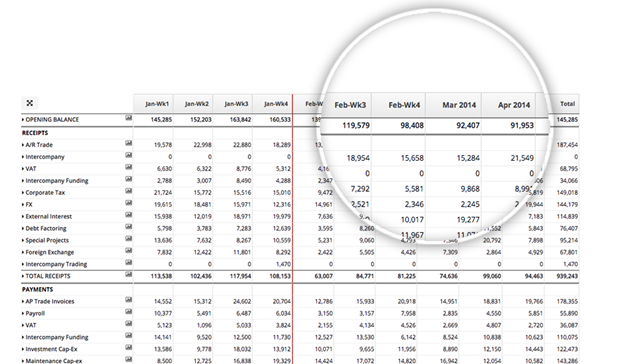
Mixed-period forecasts combine different time increments within a single model. For example, a weekly cash flow forecast might cover two weeks of daily projections followed by four weeks of weekly projections.

This approach provides detailed visibility where it matters most while maintaining a broader view over a longer horizon. Most organizations collect forecasts on a weekly or monthly basis from business units. Forecasts can be rolling or fixed-term. A rolling cash flow forecast extends with each new submission; a fixed-term forecast counts down to a defined endpoint such as quarter-end or year-end.
How Do You Forecast Cash Flow?

To forecast cash flow accurately, define your business objectives, select an appropriate time horizon, choose a forecasting method and source reliable data. Here are the steps:

Review your goals and business plans

Build the framework of your cash flow forecast around them. Key factors include short-term liquidity requirements, interest and debt reduction targets and growth planning.

Select a time period

Refer to the sections above to choose the right horizon (short, medium, long or mixed) for your organization.

Direct vs. Indirect Cash Flow Forecasting: Which Is Better? 

Direct forecasting relies on actual cash data updated daily or weekly. Indirect forecasting uses projected income statements and balance sheets. Direct is better for short-term liquidity tracking; indirect is better for long-range planning and budgeting.

Source the data

Gather data from your accounting software or bank accounts. You will need your opening balance, projected cash inflows and projected cash outflows for the forecasting period.

Using a spreadsheet to track this information initially is a practical starting point. As your business scales and forecasts become more detailed, a dedicated platform becomes more efficient. Ripple Treasury's GSmart AI connects directly to your bank feeds and ERP systems, automating data collection and eliminating the need to compile figures from multiple sources manually.

For a step-by-step breakdown of how to build and manage a forecasting process end to end, see our guide on setting up a cash flow forecasting process.

Kickstart Your Cash Flow Forecasting Process With Our Free Template

Cash flow forecasts are the primary tool for forward liquidity planning. Their format and duration vary based on each business's specific requirements. Finance teams structure their forecasts based on what matters most to the Treasurer, CFO and executive leadership. A robust and accurate cash flow forecasting process, with clear accountability built in, is a strong indicator of fiscal discipline.

If you are looking to get started, our free cash flow forecasting template gives you a structured starting point. The cash flow forecast example below lets you make weekly cash flow projections and includes fields for receipts, payments, expenditures, net cash flows and closing balances.
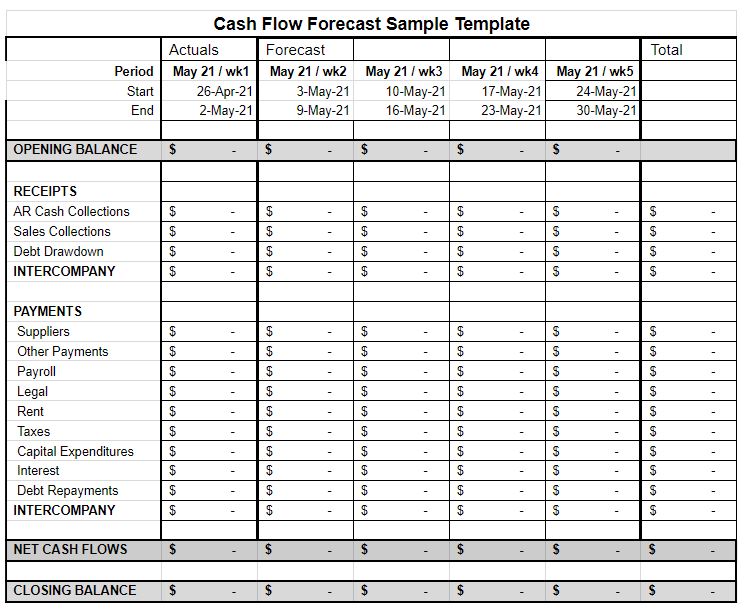
Open the template here. To use it, make a copy or download it as an Excel file.

Frequently Asked Questions

What is a cash flow forecasting template?

A cash flow forecasting template is a standardized document or spreadsheet used to input estimated cash inflows and outflows, helping businesses calculate future liquidity and identify potential cash shortfalls. Templates typically include fields for opening balance, receipts, payments, net movement and closing balance.

What is a cash flow forecast example?

A cash flow forecast example shows projected cash inflows and outflows over a defined period, with a running closing balance that shows where your cash position will be at each point in the forecast. A 13-week rolling forecast is the most common example in enterprise treasury management, with weekly columns and line items for each cash flow category.

How often should I update my cash flow forecast?

For short-term cash flow forecasts, daily or weekly updates are best practice. Medium and long-term forecasts should be reviewed and adjusted monthly to reflect actual performance and changing conditions.

Direct vs. Indirect Cash Flow Forecasting: What Is the Difference?

Direct forecasting is better suited for short-term liquidity tracking by logging actual cash receipts and disbursements. Indirect forecasting works best for long-term planning by adjusting net income for non-cash items using balance sheets and income statements.

What is the difference between a rolling and a fixed-term cash flow forecast?

A rolling cash flow forecast extends with each new submission, maintaining a consistent forward horizon. A fixed-term forecast counts down to a defined endpoint such as quarter-end or year-end. Rolling forecasts are the more common format for operational liquidity management.

Ready to Go Beyond Spreadsheets?

Our free cash flow forecasting template is a strong starting point. When your business grows in complexity, adds entities or starts managing cash across multiple currencies, a dedicated platform gives your team the accuracy and efficiency a spreadsheet cannot.

See how Ripple Treasury handles cash flow forecasting >>

Related Cash Flow Forecast Content:

What Is a Cash Flow Forecast (Examples + Template)

What Is a Cash Flow Forecast? (Examples + Template)

Written by
Ripple Treasury
Published
May 12, 2026
Oct 29, 2013
Last Update
May 12, 2026
Download the guide

A cash flow forecast is a financial management tool used by finance and treasury professionals to estimate future cash inflows and outflows over a defined period. The primary purpose of cash flow forecasting is to support liquidity management by ensuring a company has sufficient funds to meet its obligations before shortfalls occur.

The larger the company, the more complex cash flow forecasting becomes. For a deeper dive into overall strategies and methods, see our complete cash flow forecasting guide.

In this post, we cover the main components of a cash flow forecast, why capturing actual cash flow data matters and the most common types of cash flow forecasts. We also provide a cash flow forecast example for different periods and a free cash flow forecasting template you can start using today.

What are the Components of a Cash Flow Forecast?

In its simplest form, a cash flow forecast shows where your cash balances will be at specific points in the future based on projected receipts and payments. This helps highlight when and where funding needs arise and allows you to take advantage of periods when excess liquidity is available.

A more comprehensive cash flow forecast shows your current cash position, whether you will have enough cash in the future, where that cash will be and what will happen along the way, including classified cash receipts and payments.

A complete cash flow forecast, whether you are working from a cash flow projection template or a live forecasting platform, typically includes:

  • Opening Balance: The starting cash position for the period.
  • Receipts: Projected cash inflows, broken down by cash flow item or classification.
  • Total Receipts: The sum of all incoming cash.
  • Payments: Projected cash outflows, broken down by cash flow item.
  • Total Payments: The sum of all outgoing cash.
  • Net Movement: The difference between receipts and payments, tracked by individual cash flow item or at a minimum as total net movement.
  • Closing Balance: The final projected cash position for the period.

Most cash forecasts structure these line items across standard weekly or monthly intervals. The cash flow items that make up the receipt and payment elements are unique to each business. Some companies track high-level accounts payable and accounts receivable cash flows; others break cash flows down to the level of individual customers and suppliers.

Broadly speaking, most cash forecasts will be structured as shown below. The image shows a cross-section of a 13-week cash flow forecast:

Why Is Cash Flow Forecasting Valuable?

Cash flow forecasting enables companies to anticipate shortfalls, optimize excess cash and make data-driven financial decisions. Beyond capturing projected positions, cash flow forecasts often incorporate actual cash flows in the same model or template.

There are four key benefits to capturing actuals in your cash forecasting model:

  1. It ensures projected cash flows start from the actual cash position, not an estimate.
  2. Historical cash flow data reveals patterns in cash fluctuation on a monthly or yearly basis that can be used to improve future projections.
  3. Comparing forecasted cash flows to actual results lets you measure and improve forecast accuracy over time through cash flow variance analysis, identifying where projections diverged from actuals and why.
  4. It helps companies avoid shortfalls by predicting cash availability in the months ahead. If a shortage is likely, finance teams can arrange funding before it becomes urgent.

Types of Cash Flow Forecasts

When setting up a cash flow forecasting template, you first have to decide how far into the future the forecast will look. This depends on your business needs and the availability of data within your organization. As a general rule, the longer the forecast, the less granular it will be.

Short-Term Forecasts

Short-term forecasts cover a period of one to four weeks and manage the day-to-day cash needs of a business. They provide a daily breakdown of cash on hand and expected receipts.

A daily forecasting process often includes automation to capture cash flows directly from bank accounts and ERP systems. Short-term forecasts are especially valuable for smaller businesses that need to know how much cash will be available for supplier payments and operating expenses, since they typically have less access to credit than larger organizations.

This example covers what a daily cash flow forecast would look like.

Medium-Term Forecasts

Medium-term forecasts project cash flows over one to six months. The 13-week cash flow forecast is the most widely used standard in enterprise treasury management, providing a full quarterly view for each submission.

Most organizations rely on accrual-based accounting, which records income based on invoice date rather than payment date. Medium-term forecasts account for this timing gap and help ensure there is enough cash to meet payment obligations as they fall due.

13-week forecasting model

LLong-Term Forecasts

Long-term forecasts project cash flows over 12 months or more, serving as strategic tools for annual budgeting and capital planning. They are the starting point for most budgeting processes and are important for assessing the cash required for growth strategies and capital projects.

Additionally, long-term forecasts are better suited for directional guidance than month-to-month decision-making, since the extended horizon reduces the reliability of individual projections. They are also essential for managing working capital and determining whether the business can self-fund its growth.

Mixed-Period Forecasts

Mixed-period forecasts combine different time increments within a single model. For example, a weekly cash flow forecast might cover two weeks of daily projections followed by four weeks of weekly projections.

This approach provides detailed visibility where it matters most while maintaining a broader view over a longer horizon. Most organizations collect forecasts on a weekly or monthly basis from business units. Forecasts can be rolling or fixed-term. A rolling cash flow forecast extends with each new submission; a fixed-term forecast counts down to a defined endpoint such as quarter-end or year-end.

How Do You Forecast Cash Flow?

To forecast cash flow accurately, define your business objectives, select an appropriate time horizon, choose a forecasting method and source reliable data. Here are the steps:

Review your goals and business plans

Build the framework of your cash flow forecast around them. Key factors include short-term liquidity requirements, interest and debt reduction targets and growth planning.

Select a time period

Refer to the sections above to choose the right horizon (short, medium, long or mixed) for your organization.

Direct vs. Indirect Cash Flow Forecasting: Which Is Better? 

Direct forecasting relies on actual cash data updated daily or weekly. Indirect forecasting uses projected income statements and balance sheets. Direct is better for short-term liquidity tracking; indirect is better for long-range planning and budgeting.

Source the data

Gather data from your accounting software or bank accounts. You will need your opening balance, projected cash inflows and projected cash outflows for the forecasting period.

Using a spreadsheet to track this information initially is a practical starting point. As your business scales and forecasts become more detailed, a dedicated platform becomes more efficient. Ripple Treasury's GSmart AI connects directly to your bank feeds and ERP systems, automating data collection and eliminating the need to compile figures from multiple sources manually.

For a step-by-step breakdown of how to build and manage a forecasting process end to end, see our guide on setting up a cash flow forecasting process.

Kickstart Your Cash Flow Forecasting Process With Our Free Template

Cash flow forecasts are the primary tool for forward liquidity planning. Their format and duration vary based on each business's specific requirements. Finance teams structure their forecasts based on what matters most to the Treasurer, CFO and executive leadership. A robust and accurate cash flow forecasting process, with clear accountability built in, is a strong indicator of fiscal discipline.

If you are looking to get started, our free cash flow forecasting template gives you a structured starting point. The cash flow forecast example below lets you make weekly cash flow projections and includes fields for receipts, payments, expenditures, net cash flows and closing balances.

Open the template here. To use it, make a copy or download it as an Excel file.

Frequently Asked Questions

What is a cash flow forecasting template?

A cash flow forecasting template is a standardized document or spreadsheet used to input estimated cash inflows and outflows, helping businesses calculate future liquidity and identify potential cash shortfalls. Templates typically include fields for opening balance, receipts, payments, net movement and closing balance.

What is a cash flow forecast example?

A cash flow forecast example shows projected cash inflows and outflows over a defined period, with a running closing balance that shows where your cash position will be at each point in the forecast. A 13-week rolling forecast is the most common example in enterprise treasury management, with weekly columns and line items for each cash flow category.

How often should I update my cash flow forecast?

For short-term cash flow forecasts, daily or weekly updates are best practice. Medium and long-term forecasts should be reviewed and adjusted monthly to reflect actual performance and changing conditions.

Direct vs. Indirect Cash Flow Forecasting: What Is the Difference?

Direct forecasting is better suited for short-term liquidity tracking by logging actual cash receipts and disbursements. Indirect forecasting works best for long-term planning by adjusting net income for non-cash items using balance sheets and income statements.

What is the difference between a rolling and a fixed-term cash flow forecast?

A rolling cash flow forecast extends with each new submission, maintaining a consistent forward horizon. A fixed-term forecast counts down to a defined endpoint such as quarter-end or year-end. Rolling forecasts are the more common format for operational liquidity management.

Ready to Go Beyond Spreadsheets?

Our free cash flow forecasting template is a strong starting point. When your business grows in complexity, adds entities or starts managing cash across multiple currencies, a dedicated platform gives your team the accuracy and efficiency a spreadsheet cannot.

See how Ripple Treasury handles cash flow forecasting >>

Related Cash Flow Forecast Content:

See Ripple Treasury


in Action

Get connected with supportive experts, comprehensive solutions, and untapped possibility today.

Request a Demo